
(This week we’re bringing you something a little different for your Sunday enjoyment. Over the next few weeks we’ll be sharing advance sample articles from our upcoming book series, Ten Provinces, Zero Crowds, guides to more than 1000 of Canada’s most overlooked and underappreciated destinations. We hope you enjoy this sneak peek, and we’d love to hear which places spark your interest.)
McNabs Island, Three Kilometres from the City, Yet a World Away
More than half a million people live in the cities of Halifax and Dartmouth on opposite sides of Halifax Harbour and well over a million in Nova Scotia. And yet only a small percentage of those people have ever visited or even know about McNabs Island.
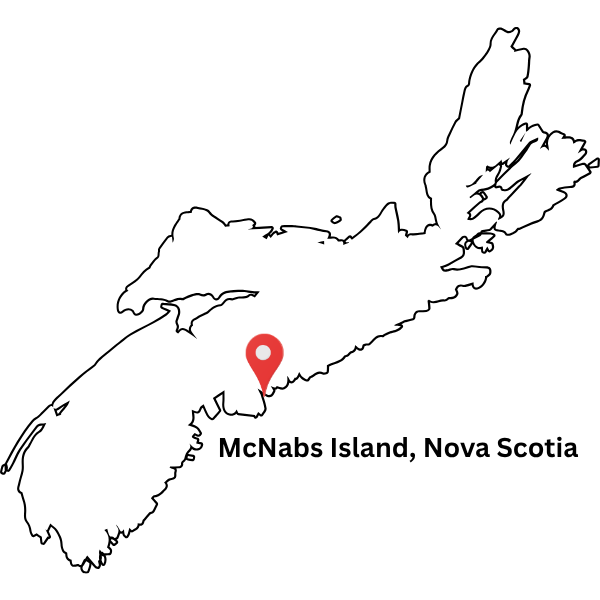
McNabs Island is a vast 395-hectare island sitting at the mouth of Halifax Harbour. Despite its proximity to the city, it remains a protected wilderness that serves as a living museum of Nova Scotia’s military, industrial, and social history. McNabs Island is a landmark that most people see from a distance but rarely visit.
It is the largest island in the harbour and is part of McNabs and Lawlor Islands Provincial Park, offering an escape from the modern skyline less than 3 kilometres away. For centuries, McNabs has been the primary guardian of Halifax. Because of its strategic location, it is dotted with fortifications that once protected the British Empire’s most important naval base in North America.
At the northern end, Fort Ives still houses massive, rusted, rifled muzzle-loading cannons. Walking through its stone magazines feels like stepping into a cold, Victorian-era fortress. Fort McNab is a National Historic Site on the south end, which was a key coastal defence battery during both World Wars. Its concrete observation posts and gun emplacements offer a panoramic view of the Atlantic. The island’s coastline is a mix of rugged cliffs and pristine cobble beaches. The long sand spit at Maugher Beach is home to the iconic Maugher Beach lighthouse. In the cove near the lighthouse, the skeletons of several old wooden vessels are visible at low tide. These derelict hulls are the remains of a once-bustling maritime era, now slowly being reclaimed by the saltwater.
In the late 1800s, McNabs Island was a popular recreation spot featuring professional gardens and a massive soda pop factory. Bill Lynch, the founder of Canada’s largest travelling carnival, once lived here. You can still find the foundations of his home and the ghost gardens where ornamental trees, now massive and wild, still grow among the native forest. The ruins of the Morrow family’s soda water factory can still be found, hidden under a canopy of trees. It is a silent reminder of a time when thousands of Victorians would take excursion steamers to the island for summer picnics.
There are over 22 kilometres of abandoned military roads and wooded paths, a paradise for hikers. McNabs remains remote because there is no bridge or public ferry. You must either charter a private water taxi or paddle over in smaller boats, which is not recommended as the harbour currents can be treacherous. Ticks are present on the island, so it’s recommended to use bug spray and check yourself after your visit. There are no stores, no paved roads, and very few facilities. Composting toilets and vault toilets are situated at several key locations on the island, but there is no running water. Visitors must pack in their own water and supplies, making it a truly wilderness experience. If you spend an afternoon wandering its uninhabited shores, the noise of the city of Halifax fades into a silence, broken only by the whistling of the wind through the fort ruins.
As of 2026, overnight camping is not allowed on McNabs Island, as the campsite has been temporarily closed since the pandemic. While it was previously a popular spot for group camping, current regulations prohibit overnight stays, and campfires are strictly banned year-round.
Writing this article reminds me of the past, as my father, Harold Parker, served in the Canadian Army as a gunner on McNabs Island during WWII. In the 1940s, the island was a military base where soldiers lived in a constant state of watchful waiting. If my memory serves me correctly, he worked with massive 6-inch breech-loading guns. These were intended to engage enemy ships and German U-boats before they could reach the inner harbour. I remember Father telling me he also spent time at the Strawberry Battery, operating the searchlights that swept the water at night, looking for submarines. The island was essentially a small city of soldiers. While Halifax was just a few kilometres away, the soldiers were often confined to the island for weeks at a time. Father once told me that to keep morale up, they had their own canteen, where they played cards and occasionally watched films in makeshift theatres.
At night, the island was plunged into total darkness. No lights were allowed except for the searchlights, making the island feel like a desolate hidden fortress. It’s quite something to think that while they were there, the safety of the entire North Atlantic convoy system rested on the shoulders of men like my father, standing watch on that small, wind-swept island.